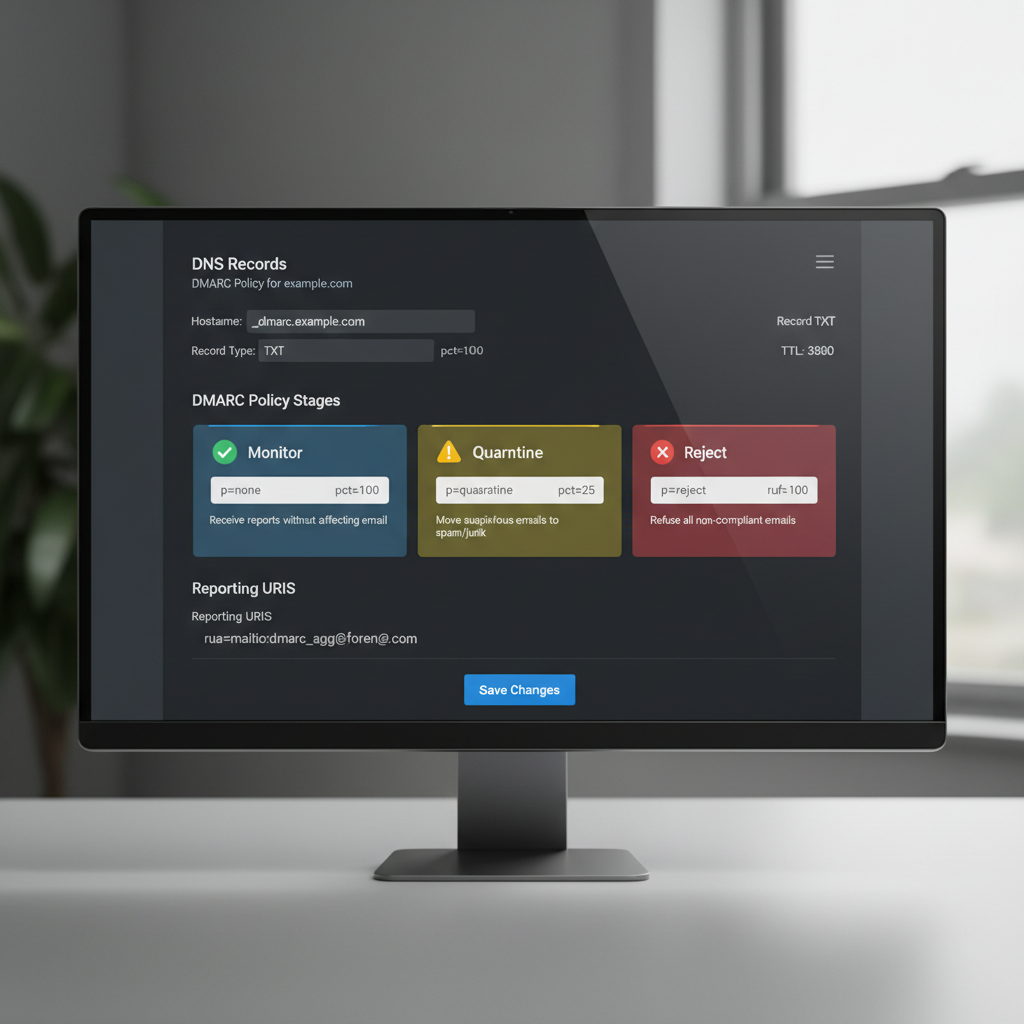
From monitoring to reject without blocking legitimate email.
Most DMARC deployments stall at monitoring because organisations fear blocking legitimate email. IP Four moves you through every stage correctly, authenticating all sending sources before enforcement so your domain is protected without disruption.
Every stage of DMARC deployment handled correctly.
DMARC policy implementation is not a single step. Each phase requires careful validation before moving forward. We manage every stage so enforcement is achieved without disrupting your business.
DMARC Monitoring Mode Deployment
DMARC deployed in p=none monitoring mode as the first step. All email continues to flow while aggregate reports reveal every source sending on behalf of your domain. No disruption to legitimate mail during discovery.
Quarantine Policy Transition
Once all legitimate sending sources are authenticated, policy moves to p=quarantine. Unauthenticated emails are directed to spam folders rather than inboxes. Controlled transition with monitoring throughout.
Full Reject Enforcement
Final enforcement stage moves policy to p=reject. Any email failing DMARC authentication is rejected outright at the receiving mail server. Domain spoofing attacks stopped completely at the protocol level.
Subdomain Policy Coverage
DMARC policy extended to cover all subdomains including those not actively used for email. Attackers frequently target unused subdomains for spoofing. Subdomain policy prevents this attack vector entirely.
Percentage-Based Rollout
Policy applied to a percentage of email traffic during transition phases. Allows gradual enforcement with real-world validation before full deployment. Reduces risk of legitimate email disruption during rollout.
Policy Documentation and Handover
Full documentation of your DMARC policy configuration, rationale, and maintenance procedures. Handover pack includes record values, monitoring setup, and escalation procedures for your IT team.
From audit to full enforcement.
Domain and DNS Audit
Full audit of your current DNS records including any existing DMARC, SPF, and DKIM configuration. Identify all subdomains and assess current authentication posture before any changes are made.
Monitoring Mode Deployment
DMARC record deployed in p=none monitoring mode. Reporting addresses configured to collect aggregate and forensic reports. No impact on email flow during this phase.
Report Analysis and Source Mapping
DMARC aggregate reports collected and analysed over 4 to 6 weeks. Every sending source identified and mapped. Legitimate sources authenticated via SPF and DKIM before policy tightening begins.
Quarantine Policy Activation
Policy moved to p=quarantine once all legitimate sources are authenticated. Monitoring continues to catch any missed sources. Percentage-based rollout used if required for large or complex environments.
Reject Policy Enforcement
Full p=reject enforcement activated after quarantine phase validates no legitimate email is affected. Subdomain policy applied simultaneously. Domain spoofing attacks stopped at the protocol level.
Ongoing Monitoring and Maintenance
Monthly DMARC report reviews to catch new sending sources and policy failures. Records updated when new services are added. Annual full review of all sending sources and policy configuration.
How we have protected UK businesses.
Accountancy Firm Domain Spoofing Attack
A Manchester accountancy firm discovered criminals were sending emails to their clients from their exact domain, requesting updated bank details ahead of year-end tax payments.
DMARC monitoring deployed within 24 hours. All legitimate sources authenticated within 5 days. Reject policy enforced on day 7. Spoofing attacks stopped completely. Clients notified and firm reputation protected.
Cyber Essentials Certification Gap
A Birmingham technology company needed Cyber Essentials Plus certification. Their assessor identified missing DMARC enforcement as a critical gap that would prevent certification.
Full DMARC implementation completed in 3 weeks including monitoring, quarantine, and reject phases. Cyber Essentials Plus certification achieved. Ongoing monitoring maintained as part of managed service.
Multi-Brand Organisation Policy Rollout
A Leeds retail group with 4 trading brands needed DMARC enforcement across all domains simultaneously. Each brand used different email platforms and third-party marketing services.
Phased rollout across all 4 domains over 8 weeks. All sending sources authenticated including 3 marketing platforms and a CRM. Full reject enforcement achieved across all domains without a single legitimate email blocked.
Check your DMARC status in 60 seconds.
Our free DMARC check tells you instantly whether your domain can be spoofed and what policy is currently in place. Takes 60 seconds and costs nothing.